An Archival Account, Ionian Sea, 1975
The Belknap
22 November 1975. A night carrier-operations accident that became a fight to save the ship.
8
Killed
≈ 50
Injured
2.5
Hours Alongside
None
Abandoned Ship
The Account Follows
The Account Begins
A carrier turned into the wind.
And then, the closing.
On the night of 22 November 1975, the guided-missile cruiser USS Belknap (CG-26) collided with the aircraft carrier USS John F. Kennedy (CV-67) during night carrier operations in the Mediterranean. The carrier's overhanging, angled flight-deck structure struck and crushed the Belknap's upperworks. Ruptured aviation fuel lines on the carrier poured burning fuel onto the cruiser below.
What followed was a major ordnance, firefighting, and rescue emergency. Eight sailors died, seven from Belknap and one from John F. Kennedy. Roughly fifty were injured. The ship survived because her crew, and the sailors of nearby U.S. Navy ships, fought the fire for hours, evacuated the wounded, supplied water and equipment, and eventually brought the ruined cruiser under tow.
A note on the screenplay
Project Extremis, the feature screenplay inspired by these events, fictionalizes the names of the ships and the people who served on them (USS POWER, USS SAMAR, USS JEFFERSON). The historical account on this page uses the real names of the real ships and the real sailors. Both are true to the night.
The Ships, The Sea
Lead ship of her class, working the night shift.
USS Belknap was the lead ship of a class of guided-missile frigates, later reclassified as a guided-missile cruiser. Built by Bath Iron Works, she was launched on 20 July 1963, commissioned on 7 November 1964, and reclassified CG-26 on 30 June 1975, only months before the accident.
By November 1975, Belknap was operating with Task Group 60.1 in the Mediterranean. John F. Kennedy was conducting flight operations, which required the carrier to maneuver into the wind. It was night, in rough weather: passing rain and thunder squalls, winds of about 15 knots, seas of 6 to 8 feet by the time the rescue ships responded.
The Closing
The angled flight deck tore into the cruiser.
The carrier signaled a turn. Belknap's officer of the deck planned to slow, let the carrier complete the turn, and then maneuver the cruiser back into station. Instead, the two ships closed dangerously. Belknap came into contact with the carrier's port-side overhang.
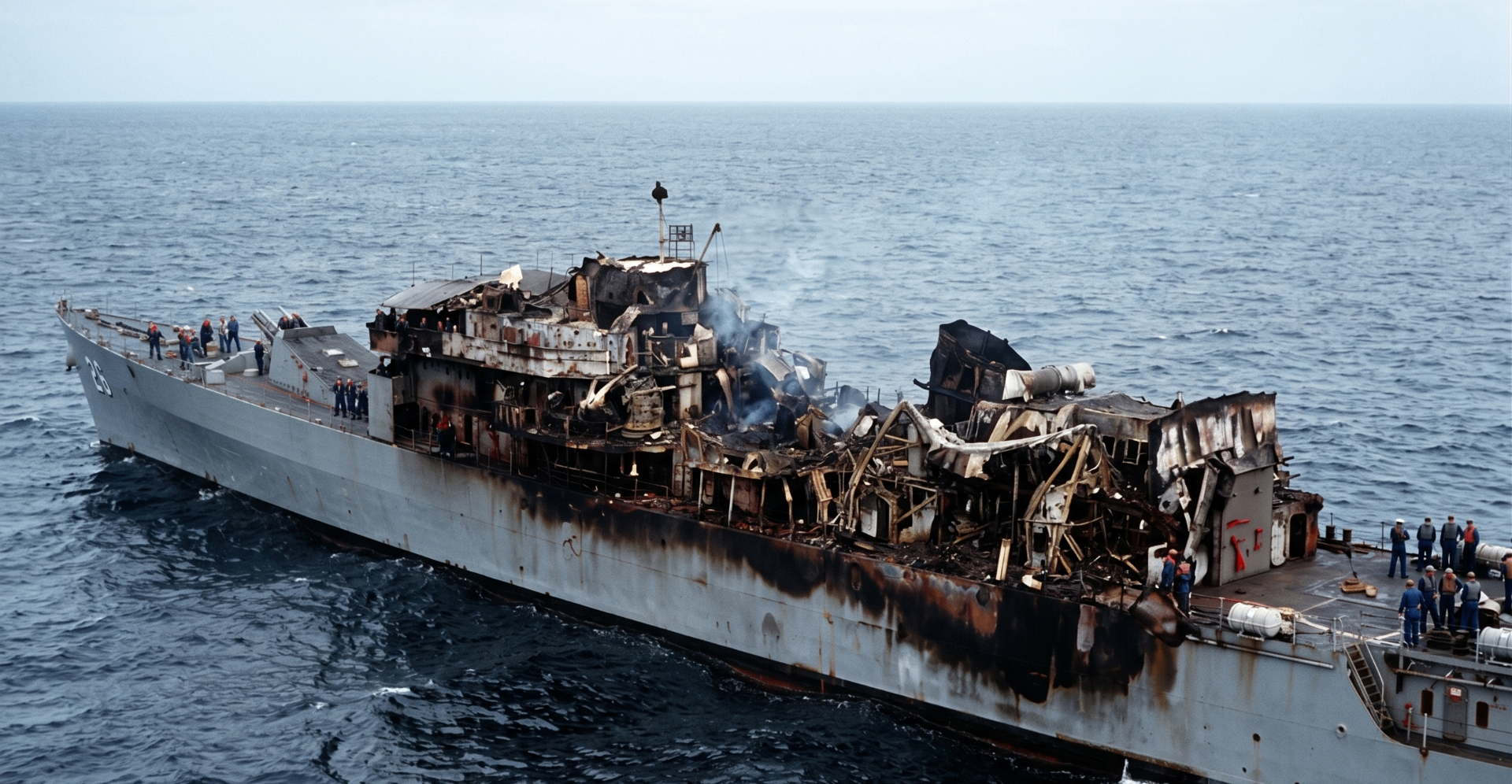
The massive carrier structure tore into the smaller cruiser's superstructure. The Kennedy's angled flight deck ruptured aviation fuel lines, sending fuel down onto Belknap, where it ignited. The collision did not simply dent the cruiser. It crushed major portions of her mast and superstructure, started fires on both ships, and left Belknap burning amidships.
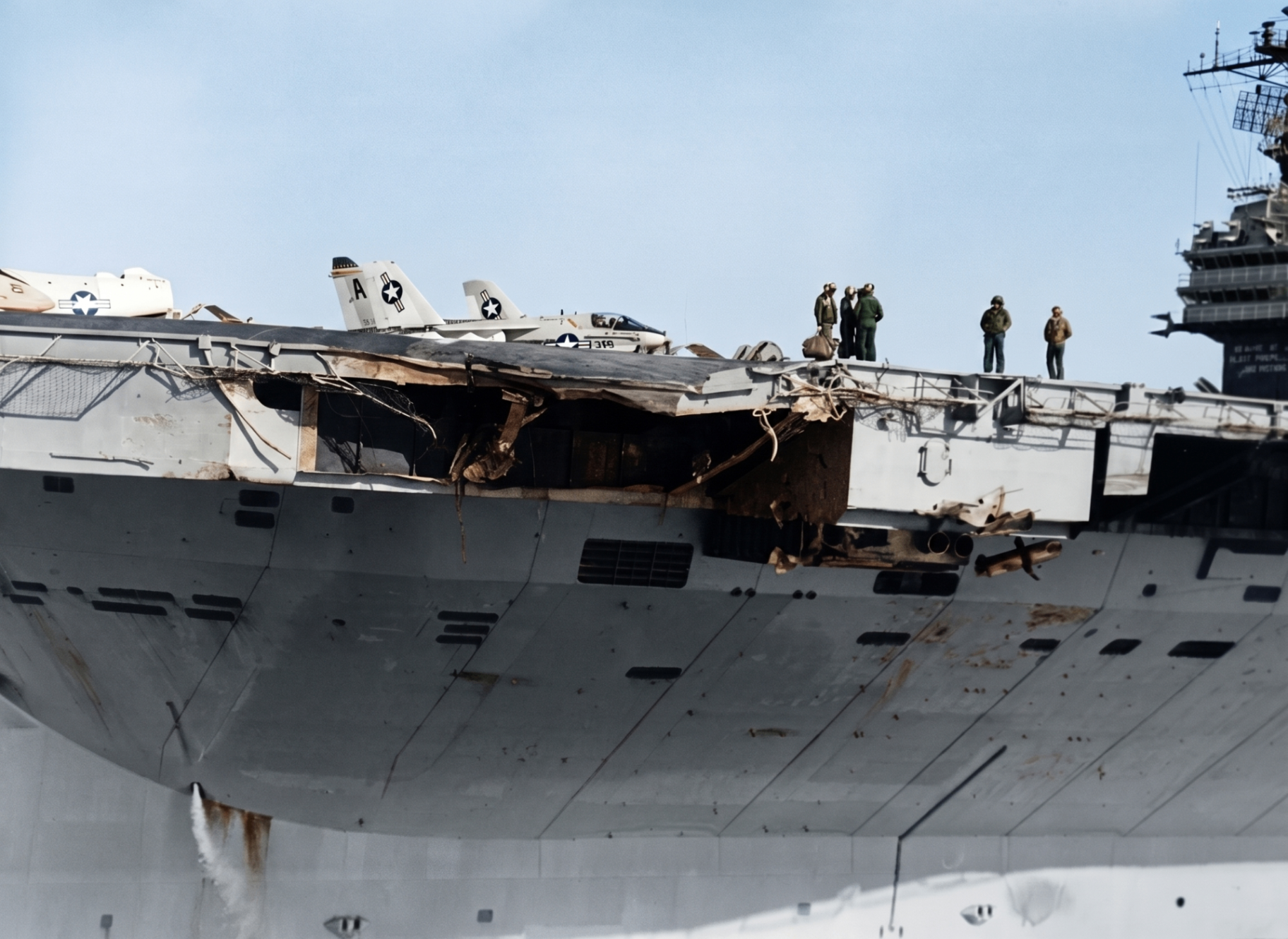
USS John F. Kennedy, CV-67
The carrier's port-side overhang, gouged open where it tore through Belknap's superstructure. Aviation aircraft parked feet from the wound. Fuel lines, severed.
The Fire
Fuel rained down from above and ignited.
Aluminum upperworks were never built to survive this.
The most destructive element was not the impact. It was the burning aviation fuel. A key reason the disaster became famous was the vulnerability of Belknap's aluminum superstructure. The hull itself was steel, but much of the upper structure was aluminum, a common weight-saving choice in the Cold War Navy. Under the intense, fuel-fed fire, the upperworks were gutted and collapsed down toward deck level.
The fire was also dangerous because of ordnance. Belknap's ready ammunition cooked off. Shrapnel rained onto the rescuing ships while crews fought to keep water on the burning cruiser. The response was, in effect, conducted alongside a heavily armed warship on fire.
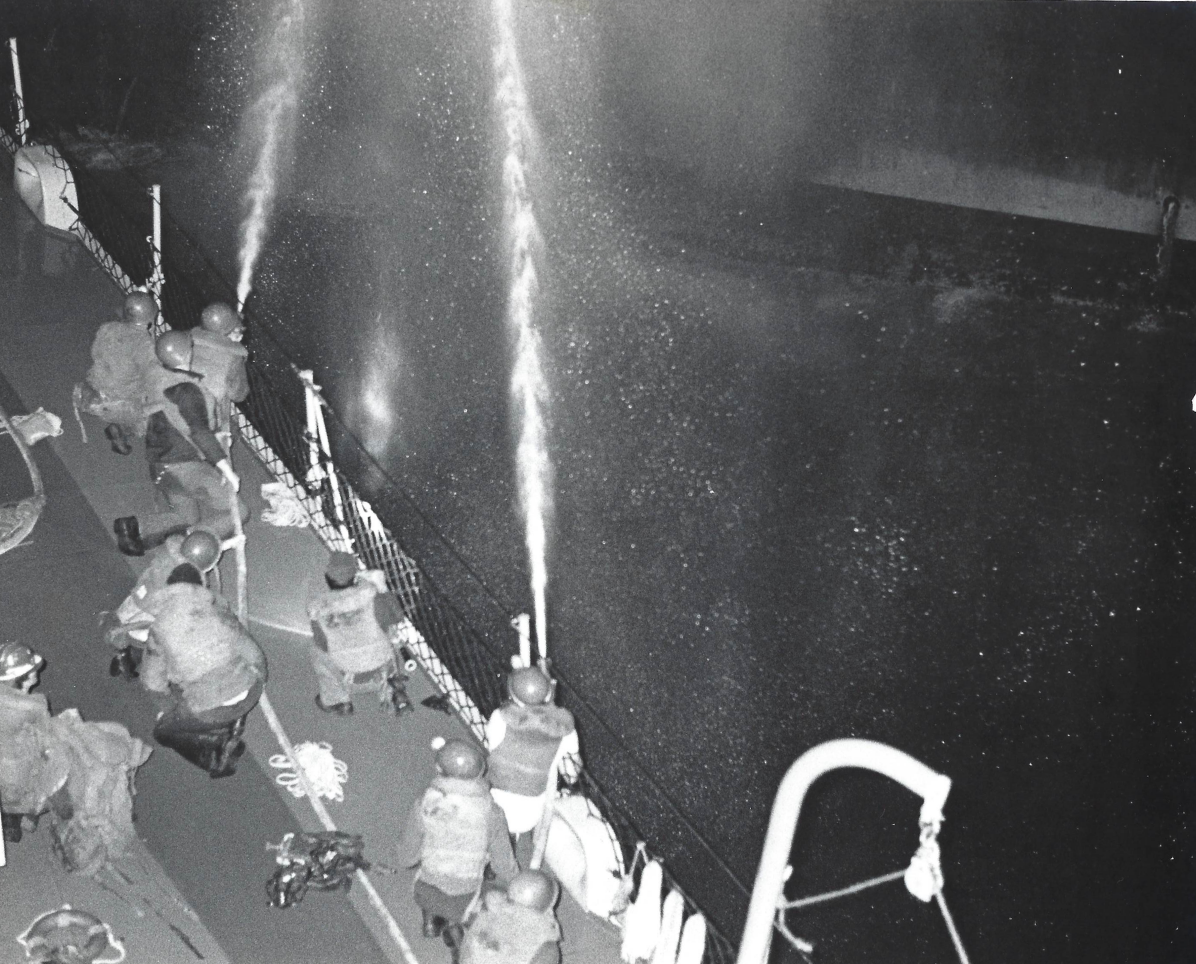
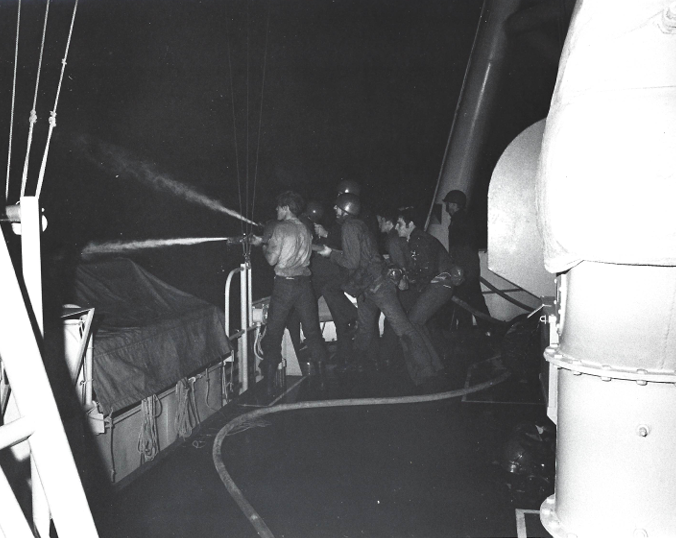
22 November 1975, Ionian Sea
Hose teams from the rescuing ships pour seawater across the gap onto Belknap's burning superstructure. 21 hoses. Six pumps.
Broken Arrow
A few meters from the warheads.
Later declassified information added another dimension. Belknap carried W45 Terrier missile warheads, and a Broken Arrow alert was issued because of the risk that nuclear weapons could be involved in the fire or in secondary explosions. By later reporting, the fire stopped only a few meters from Belknap's nuclear weapons magazine.
The alert was serious, and later downgraded after the Navy determined no nuclear weapon had been directly damaged or immediately physically endangered. The danger was real enough to trigger emergency reporting. The event did not become a nuclear detonation or a radioactive release.
The Assist
21 hoses. Six pumps. No one abandoned ship.
The rescue effort involved multiple ships. USS Claude V. Ricketts rushed in from about three and a half miles away. USS Dale, USS Thomas C. Hart, USS Pharris, and USS Bordelon were also assigned rescue, medical evacuation, search, firefighting, or towing roles.
Ricketts came alongside Belknap and used extensive hose teams to fight the fire: 21 hoses, six fire pumps, and an estimated 2,500 gallons of seawater per minute at one point. Small boats evacuated burned and injured sailors in heavy seas. Ricketts also transferred pumps, nozzles, first-aid supplies, clothing, water, oxygen-breathing-apparatus cylinders, and other emergency items to Belknap.
USS Bordelon helped extinguish stubborn flames and later took Belknap under tow, bringing the cruiser to Augusta Bay, Sicily. After roughly two and a half hours alongside the burning ship, the fires were declared out. No one abandoned ship.
The Fallen
Eight names.
In Memoriam
- YN2 David A. ChivaletteUSS John F. Kennedy
- MM1 James W. Cass
- MM2 Douglas S. Freeman
- EM2 Michael W. Kawola
- DS3 Gerald A. Ketcham
- STG3 Brent W. Lassen
- FA David A. Messmer
- DS2 Gordon T. St. Marie
USS Belknap unless otherwise noted. Approximately fifty more were injured.
October 1976
Command responsibility, distinguished from criminal guilt.
The formal Navy investigation led to accountability proceedings. Admiral James L. Holloway III, Chief of Naval Operations, summarized the matter in a memorandum dated 2 October 1976. The investigation held Belknap's commanding officer and officer of the deck accountable for the collision.
The commanding officer was referred to a general court-martial, though the disposition was described as tantamount to acquittal. The officer of the deck was convicted of three charges but sentenced to no punishment. Holloway used the case to draw a line between command responsibility and criminal guilt, emphasizing that command responsibility remained a core naval principle even where a criminal trial did not produce severe punishment.
30 January 1976, May 1980
Towed home. Rebuilt. Returned to the fleet.
Despite catastrophic damage, Belknap was not scrapped. She was towed back to the United States and rebuilt at the Philadelphia Naval Shipyard. Reconstruction began on 30 January 1976. The rebuild included a new and improved 5-inch gun, updated missile systems, sonar, communications, and radar equipment.
Belknap returned to active service in May 1980. She later served as flagship for the U.S. Sixth Fleet, homeported forward at Gaeta, Italy, and was the U.S. flagship during the 1989 Malta Summit between President George H. W. Bush and Soviet leader Mikhail Gorbachev. She was decommissioned and struck from the Navy list on 15 February 1995, and was later sunk as a target on 24 September 1998.
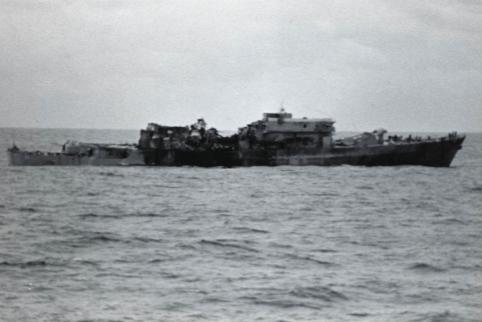
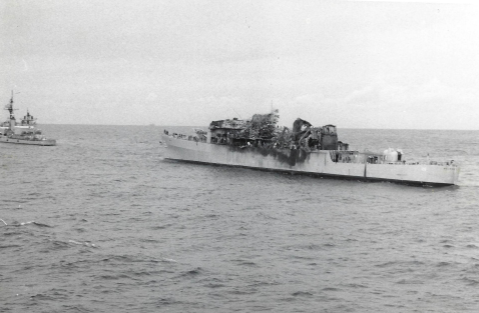
The Morning After
What was left of the cruiser's upperworks. Steel hull intact below. The rebuild would take four years.
The Legacy
The reason later combatants are built of steel.
Belknap became one of the Navy's clearest warnings about aluminum superstructures on major surface combatants. Aluminum saved weight high in the ship, but it performed poorly in a severe, fuel-fed fire. Because the fire would have caused less damage had the superstructure been steel, the Navy began pursuing all-steel construction in future surface combatants.
The Belknap fire was not the only factor in later U.S. Navy design decisions. Later combat experience, including the Falklands War, also influenced survivability thinking. But Belknap strongly reinforced the move away from aluminum upperworks in major combatants, and toward steel superstructures in later ships such as the Arleigh Burke class.
"There's a lot of damage control inside a ship. If one station takes a hit, another picks it up."
In Closing
More than a collision.
A night carrier-operations accident. A fuel-fed shipboard inferno. A mass-casualty event. A nuclear-safety scare. A command-accountability case. A turning point in U.S. Navy thinking about ship survivability.
The tragedy killed eight sailors and injured about fifty. The ship did not sink. Through the actions of Belknap's crew and the sailors aboard the assisting ships, the cruiser was kept afloat, rebuilt, and returned to service for another fifteen years.
That survival is why the event is remembered. Not only as a disaster, but as a major example of naval damage-control courage.
Sources, Works Cited
The record this account is built on.
Where sources differ, particularly on injury totals, ranges are given rather than a single forced number. Casualty figures of eight killed and forty-seven injured follow the Naval History and Heritage Command summary.
- 01H-071-2: U.S. Navy Surface Ship Accidents Since World War II
Naval History and Heritage Command
- 02Short History of U.S. Navy Accidents and Non-Combat Losses
Naval History and Heritage Command
- 03Belknap II (DLG-26), Dictionary of American Naval Fighting Ships
Naval History and Heritage Command
- 04Proceed to Assist, The Belknap Ablaze
Cdr. Robert C. Powers, USN. Proceedings, U.S. Naval Institute, August 1976
- 05USS Belknap Collision
Bath Iron Works Legacy Vault
- 06CNO Memorandum Re: Belknap/Kennedy Collision, 2 October 1976
Adm. James L. Holloway III. U.S. Naval Institute Blog
- 07History of USS Belknap DLG/CG-26
USS Belknap Association
- 08Declassified: U.S. Nuclear Weapons at Sea
Hans M. Kristensen. Federation of American Scientists, 3 February 2016
- 09Belknap touched off nuclear accident alert
United Press International, UPI Archives, 25 November 1989